
Listen to the story read by Jo. or read below. Click “View Entire Message” if the post exceeds the limit of your email provider. This post discusses incest abuse. If you’re a survivor or supporter seeking resources, head over to Incest AWARE or Sibling Sexual Trauma.
It would take a number of steps to descend the mountain top in Orvieto, Italy and arrive in Croatia. An early morning walk to the train stop. Then a ride to Rome. Then another to the airport. Then a flight to the country known as, “The Pearl of the Adriatic Sea.” Then a bus ride to a new town also called, “Old Town,” in the city of Dubrovnik, which means “Grove.” So I arose and began the journey. I walked in the rain, then boarded the train, then jumped on the next, then got on the plane, then landed, then waited for the bus to pick me up curbside.
Before I arrived in Europe, I took a virtual writing workshop taught by a woman named, “Vanessa.” Vanessa means, “Butterfly,” which was a strange synchronicity as I managed this change and practiced the life of flight that I had dreamt for so very long. One day, Sol from Argentina read about her life. Sol means “Sun” and her light glowed on screen, as well as in her writing. Her words could also burn: something I loved about her. She wrote about how her mother used to wake her up every morning and ask:
“What are you going to do with your freedom today?”
The bus arrived. I chose a seat, stared out the window gazing at the sea, and remembered the dream that had brought me here sitting still in my body since 18. I had worked diligently and waited desperately for the finances, the freedom, and the flexibility of health to take a solo European journey. I decided on this leg of my travels due to the advice of friends. One after the other recommended it as a stop in my six week stay in Europe. So I listened to them. As the bus pulled up to our destination, immediately I felt glad I did. Then wondered:
Did I choose Dubrovnik or did Dubrovnik choose me?
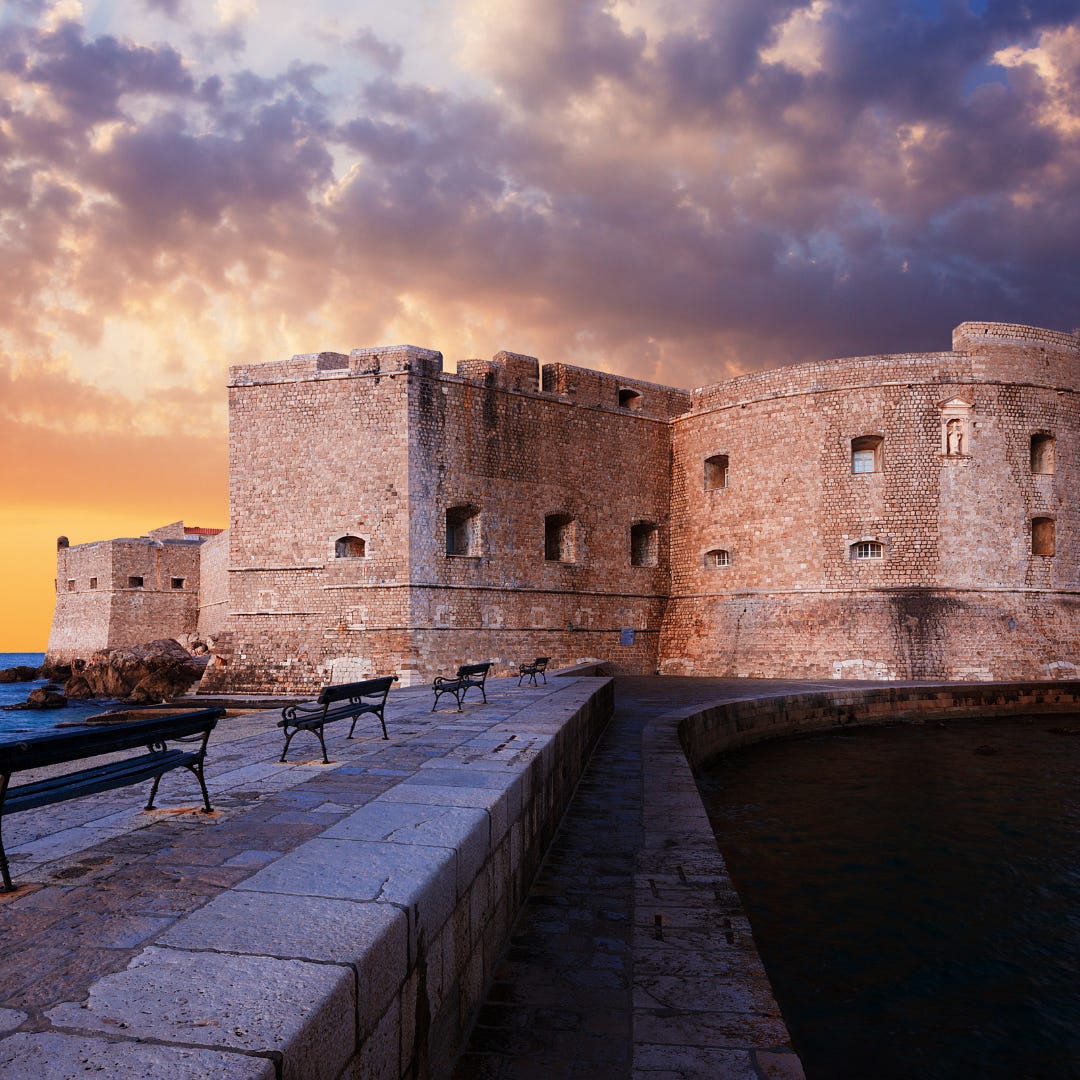
The old town sat on the edge of gray rock cliffs that rested near the ocean. The glistening deep blue turquoise hued water with white caps lapped the surface creating a splash. A golden beach stretched to my left, while the brown mountains arose to my right. A bustling town alive with locals and merchants and tourists welcomed me.
Then there were the walls. Tall stone slabs stacked in a circular shape formed a fortress with a number of gates that used to be used to keep some in and others out. Now locals lived within the enclosed town and tourists visited, while the gates remained open endlessly. Free. The city repurposed for peace, celebrating safety. The walls now available to walk atop for a fee.
I deboarded the bus, strapped my backpack around my back and my fanny pack to the chest strap and walked toward my hostel. The gates towered above me with an inscription carved on them in Latin that translated to:
“Liberty Should Not Be Sold At Any Price.”
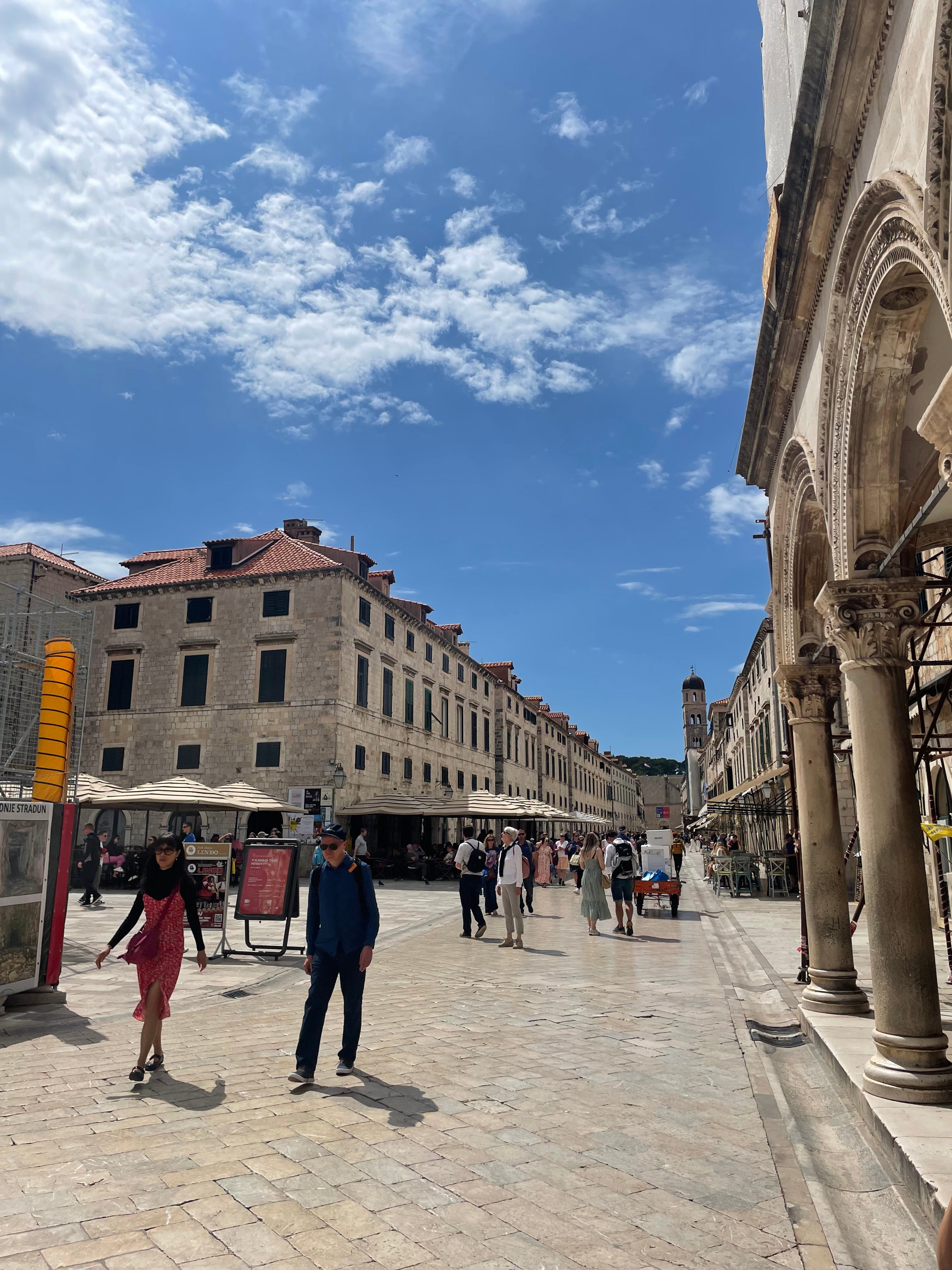
I agreed and kept walking slowly as people crowded the small entrance around me. I pushed my way through them until the entire town opened. A church lifting to my left, stores to my right, restaurants in front of me with more outdoor seating than I had ever seen. A surprising number of cats roamed around the city. A friend had warned me that the tiles underfoot would be slippery, so I treaded carefully as I slid along the sand tan stone. Classical music filled the air from every direction, but its source remained a mystery.
The hostel sat just near the top of a steep set of stairs. I could see the laundry hanging from the lines on the second floor. I climbed step by step until I arrived to a small white front door, then pushed it open. In front of me, a long, narrow hall stretched to the back of the hostel. A spiral staircase to my right stood erect. A closed door to my left. No service desk. No people. I called the hostel owner. He answered immediately.
“Hello?” He said in a deep voice.
“Hi, this is Anne. I’ve arrived.” I replied.
My passport still had my birth name on it, so I reserved all of my flights and hotel stays under Anne Marie Markel. Anne means, “Favored one.” Marie means “Rebellion.” Markel stems from Mars, the Roman God of War. Now, 36 years after my family passed that name down to me, I had already fulfilled my destiny as the Favored Rebellion to the God of War by surviving intergenerational incest, then running.
I left my family first, then the institution of family second. A word that derives from the Latin, “Famulus,” which means “servants or slaves.” Family then meaning, “The servants or slaves of a household.”
Today, for some, the nuclear family system can be a fortress — a small community of safety and belonging that protects children from the complexities of contemporary challenges. For others, the fences and walls become the doors behind which secrets are stored. A fortress not to protect, but to conceal the realities of maltreatment. Domestic violence, verbal and emotional abuse, neglect, and incest, can be hidden in homes far too easily. Then passed down intergenerationally.
Without the aid of extended community, children manage the impacts of intrafamilial violence until they’re old enough or bold enough to leave. If they ever can. With such a strong focus on morality and identity and social and financial securities provided by the family, and without an alternative safe place to land, many victims must stay. If the institution of the nuclear family fails some of us, then it fails all of us.
So I chose to stay family-free. I knew I couldn’t take on the labor of a new family system after liberating myself from my first one — especially not as a person with a uterus who would be required to literally carry most of the burden. Instead, I formed an extended community and claimed a new name.
I started with the last, “Lauren,” which comes from the Laurel leaf, a symbol of victory and resurrection. Then the first, “Josephine,” which means, “The expansion of Yahweh.” Some say this is the Hebrew word for “God,” but the more direct translation is, “To be.” I dropped Marie, smooshed Anne in between, and became the “Expansion of being — a favored victory.” I now aspire to be the opportunity this name offers me.
As I toured Europe as a gift to myself after my brutal commitment to liberation and healing from illness and incest and the illusions of the union of the nuclear family, I celebrated as I didn’t feel one bit triggered to hear everyone call me “Anne Marie.” As she, although an outgrown identity, had succeeded in her purpose to survive the past and to stay in the present, so I could try to live fully. But without the blueprint of family in my future, I couldn’t help but wonder:
What was next for me?
Room four apparently. “Aw, Anna!” The hostel owner, Goran, replied in an urgent and fierce tone. “I’m out now. Wait an hour and I’ll be back. Go to room four. Room three will be yours, but it’s not ready.” Goran, which translates to George, means “Earth worker.” I worried something was wrong. Goran had agreed to meet me at my arrival time. In his absence, I figured he must be out addressing something serious.
I walked back up the stairs, opened the bedroom door that had a four on it and dropped off my bags. Then checked out room three. It was bigger and better, so I felt grateful for his decision. I pulled out my hand-me-down laptop and began working. But an hour passed and Goran was still not back. I started to get hangry — hungry and angry. It had been three hours now since I had arrived. I chose to stop waiting, locked the door, and left for dinner.
I found some food then followed the music. Those classical sounds that carried through the air in this old town. They led me to a church where I could pay to enter and listen to the musicians play. I handed the woman at the door a few dollars, then found a seat in a pew in the very back row. The music filled the intimate space between the walls, candles lit to brighten the view. Jesus nailed to the cross hanging over those beautiful sounds. All a symbol for my life at this moment. This duplicity. My suffering hovering above all this majesty. I didn’t know how to integrate my past and my present. My oppression and my liberation. My brain spun with a central mystery:
How could I possibly be this free in a world still steeped in violence and misery?
Survivor guilt haunted me. The grief from having so much of my time wasted fighting then freeing myself from violence as I discovered a life on the other side of the family fortress that harmed me. The reality is that so many don’t survive. So many run away only to be kidnapped and trafficked. So many don’t find a way from incest to a life of travel of play. So many children were still being abused while I was sitting in a pew staring at the cross with the man who was supposed to save me, listening to the melodies, reflecting on the freedom born from the courage of leaving, the commitment to healing, and the collaboration of liberation within community.
Then I remembered my ancestors’ own labor to liberate. My mother and her mother and her mother before that. The ones who once were legally considered property. The ones who couldn’t choose to be child-free. The ones who had no economic opportunities. The ones who had to bear the burdens of family. Who were forced to travel due to the need to leave everything they knew behind in flights from plights of poverty and famine. Or my grandfather’s mother, Pearl, who gazed up to the Appalachian mountains, while raising her 12 children in a one room cabin in a coal mine camp in West Virginia. I heard the voice of adrienne maree brown, then mine, say:
“I am my ancestors’ wildest dream.”
So, who am I not to be free?
I carried this question with me and wept as I walked home back up the steps. I found my stuff awaiting me in room three, unpacked, laid down, and slept.
I arose the next day, peeked out the window to say good morning to the sun, and asked myself that question from my friend who held the name of that same bright star:
What am I going to do with my freedom today?
I headed downstairs to start exploring. A man met me on the bottom of the first floor. “You must be Anna,” he said in a deep voice with that familiar strong and intimate tone I had heard a few times over the phone. “I’m Goran. I got back late last night.” I expected him to provide an excuse about an emergency with a family or friend. “Yesterday was my happy day!” He explained. “I was out with my man friends and didn’t want to come back.”
My body filled with frustration, confusion, and celebration all at the same time. The tourist in me felt pissed that he was swinging back beers with his friends while I played musical chairs in rooms and waited for him. But the liberator in me applauded him for breaking the constructs of exploitative capitalism by prioritizing his own happiness.
“Okay,” I laughed. He took out a map and showed me all the great places to be in this old town and just outside the gates where the ocean lapped the shoreline. How to climb those beautiful brown mountains safely. He wished me well and I went on my way. I walked out the door and began to explore. Coffee always the first agenda item of the day.
Still early, the tourists slept, granting me a sense of intimacy with this city as I roamed silently. Not even classical music had filled the air just yet. I found the coffee shop, ordered a cold brew, and searched for a place to sit. Two benches rested in an L-shape with a table in between within a small garden. Plants climbed the walls, flower pots paraded around, cats sat everywhere. Clean, it seemed as if the community cared for these little lions well. In return, they kept the streets free of rodents. So, I sat with the cats.
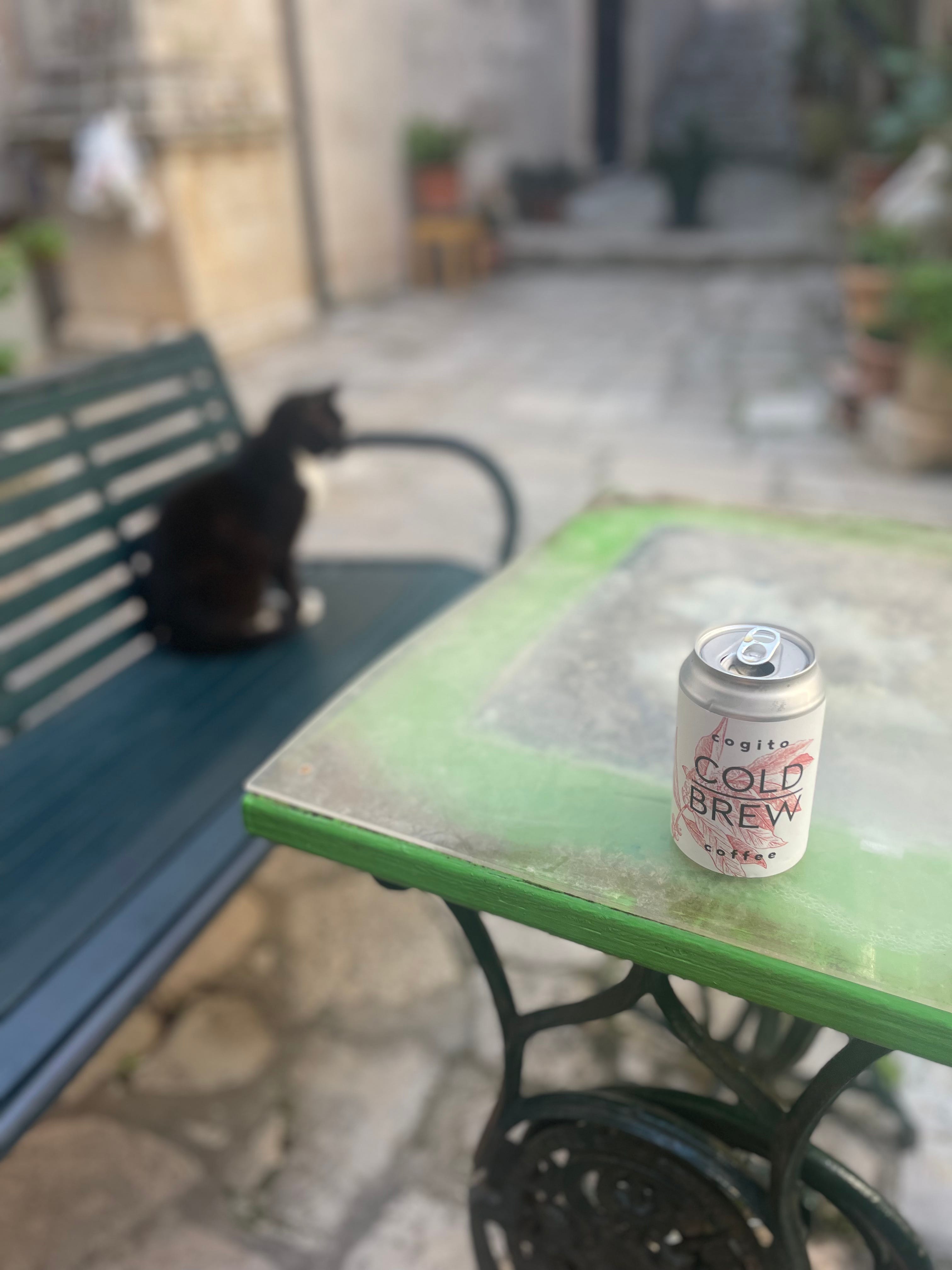
Many cultures have historically practiced “animism,” or the belief that animals have spirits that interdependently interact and guide human beings. In some traditions, cats help humans to have courage to explore the unknown with their sharper nocturnal vision. Mystery was exactly what I was encountering in this beautiful city. Not the old churches, or the stone walls, or the proximity to the water. The privileges of my life thus far had led me to all these beauties before, although not right next door to each other.
Instead, the unknown met in this fortress in Dubrovnik was simply ease. Suddenly nothing was abusive, nor an emergency. Travel was available. Money accessible. Remote work possible. Health enjoyable. My energy redirected from survival toward fulfilling dreams. The cost of my liberation journey had finally paid off and I was literally learning to bask in the warmth of this new reality.
But the brain often processes unfamiliarity as a lack of safety. If what’s familiar is abuse, neglect, pain, stress; then the opposite: love, commitment, care, and relaxation; can be interpreted as problematic. The brain has to work hard to process new experiences. Simply put, freedom didn’t feel so free. I felt grateful so many cats stayed close to me as I explored this mystery and asked myself:
What does freedom mean for me?
The model for freedom dictated by the class culture I was raised in didn’t make much sense to me. To do whatever I wanted, as long as I didn’t violate the rights of another. But in order to simply exist in a world as complex as this, I had to participate in institutions that benefited me and harmed others. Individual liberty at the expense of institutional justice and equity. Personal achievement at the cost of community.
It was tempting to just be self-centered and focus on my best life without thinking of the needs of the greater community. But it was exactly this selfishness that justified my abusers’ actions against my body. Alternatively, it was the community I created after leaving my family who sacrificed so much of themselves to help me become free.
Today I got to do whatever I wanted for the most part, but still didn’t have the tools to know what I wanted to do. To define a life of pleasure and ease without a father, or a family, or a savior, or Complex-PTSD, or capitalism, or justice, or the need for community, or the fulfillment of someone else’s dreams guiding me. So thoughts swam in my head in the space between. Past, present, and future all still living in my body simultaneously, swirling around trying to compartmentalize and reorganize and decide what to do with the next stage of my life. I kept myself active so as not to get lost in the cognitive process, finished the coffee, said goodbye to the cats, and headed to the ocean.
I walked down the narrow, long stone path until I found the marina. My fingers dragged along the outside of the walls until a number of rocks piled up against the stone barricade that opened to a small swimming hole. A rope with buoys boundaried the swim area. An island stretched off to the distance and behind that and to the right of that and to the left of that sat an endless horizon. One of my favorite things. Raised near the sea, trips to the beach served as my first form of therapy. This was familiar to me.
Camille Kouchner, the twin sister of an incest survivor, wrote a book called La Familia Grande that contributed to the creation of the government’s Commission on Incest and Sexual Violence against Children (CIIVISE). As she held her new baby in her arms, she expressed that she wanted a horizon for herself and her family without incest. I shared this desire deeply in my body, as I stared out at that place where the sun found the sea endlessly and wished for a future with more days to be free. Then I went to the water, dove in, and let the cold fluid touch my skin. I floated effortlessly. This ease also so familiar to me.
The next day I woke up and heard the sun’s voice arising beyond the horizon say:
“What are you going to do with your freedom today?”
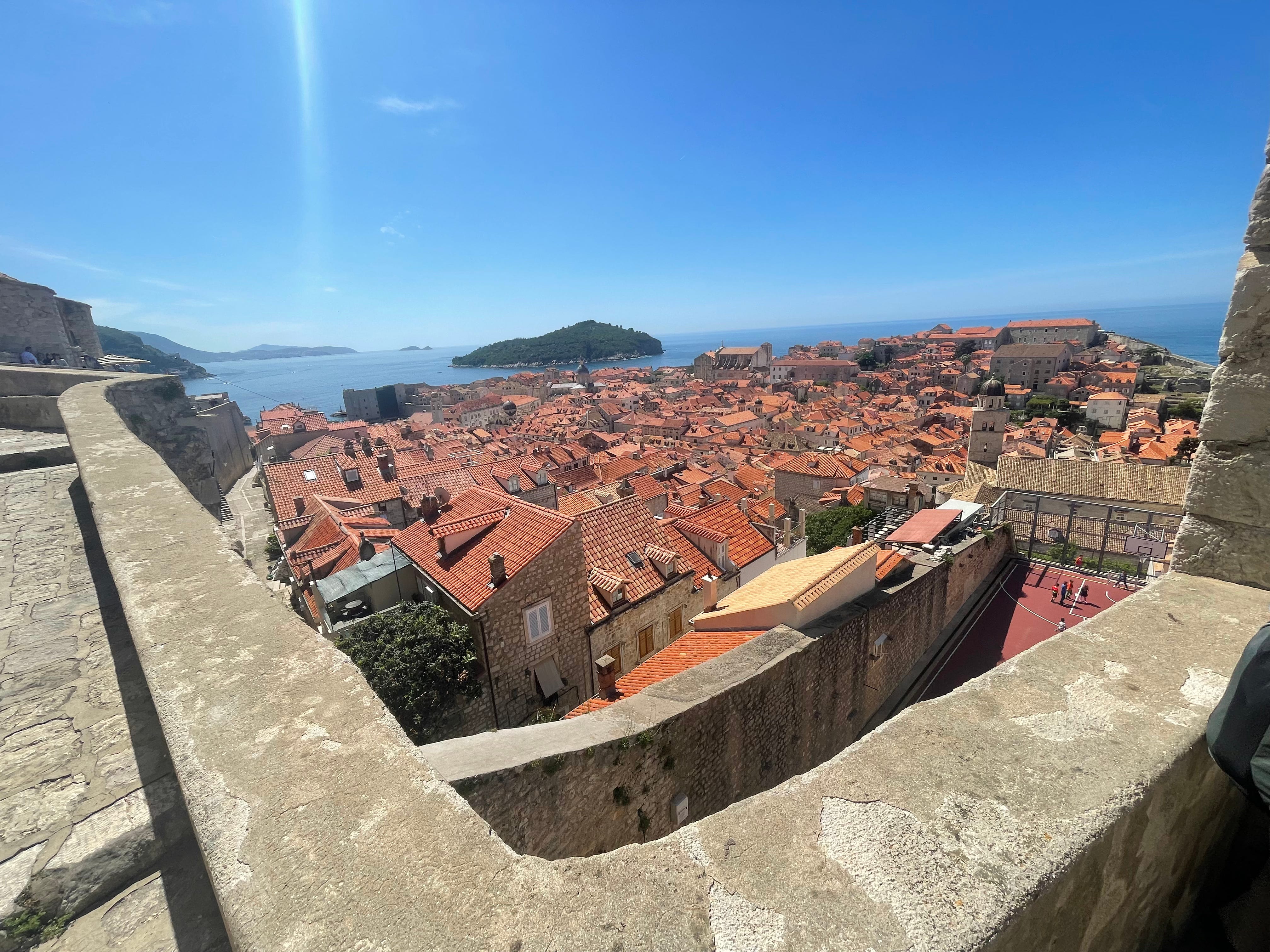
I chose to walk the walls. I dragged my fingers across the hard stuck stone and reflected on the repurposing of this fortress. The walls were not built for this. To have permanently open gates with tourists and locals flooding in and out at will. No, they were built to be closed as early as the seventh century. To protect its first inhabitants: Roman refugees. To help those within survive the violence of those on the outside. To avoid death. To experience some semblance of a life. For centuries, the walls had survived. For now, the walls were free after a complicated history. I climbed the steps.
As I stood atop those repurposed stacked stones, I gazed once again at the endless horizon and thought of Kouchner’s dream for a family without incest. I wanted this safety for everybody, not just for me and wondered:
How do I enjoy the freedom so precious to me and also commit to the liberation of my community?
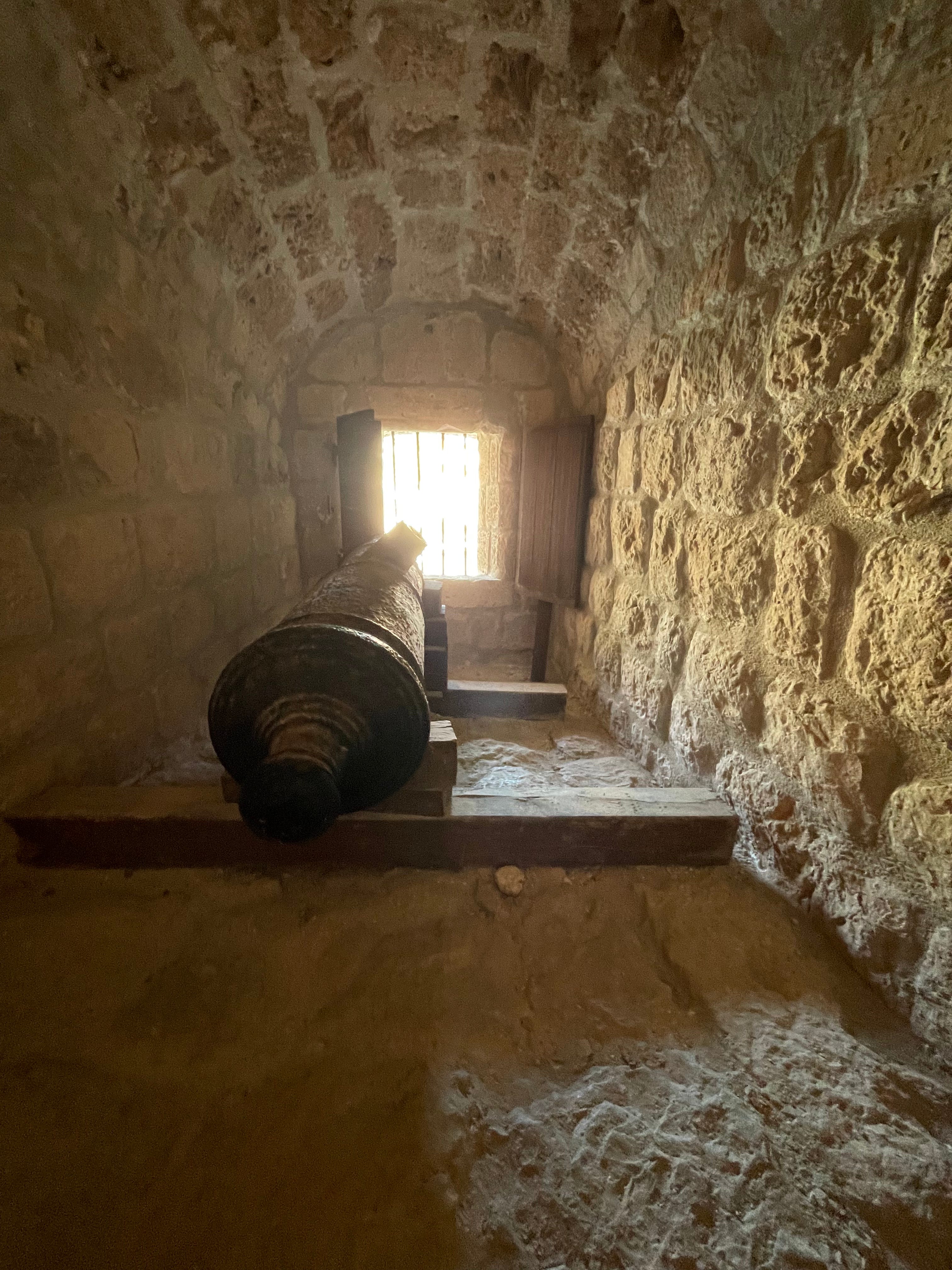
I found the rooms that hid the cannons that remained from those years of war. Retired now and viewed for sport. The history of conflicts absolved into simply a memory. A museum. The process of adjusting to being and staying free a price this community also had practiced. They took their freedom seriously and not just for themselves, but for everybody. Dubrovnik was one of the first places in Europe to ban slavery in 1416. Additionally, in their own process of building a free and safe community, they centered the protection of children: the first orphanage in Europe was founded within this old town in 1432.
Dubrovnik was teaching me. Providing possible answers to the questions that swirled around in my head. Helping me to understand a new way of being free that integrated not erased history, invited enjoyment of freedom, and encouraged responsibility of communal safety and equity. By practicing pleasure, while digesting and sharing my story. Ending slavery. Protecting the next generation of children. Building communities with values of equity and peace. And, like Goran, every once in a while neglecting what was expected of me to be happy.
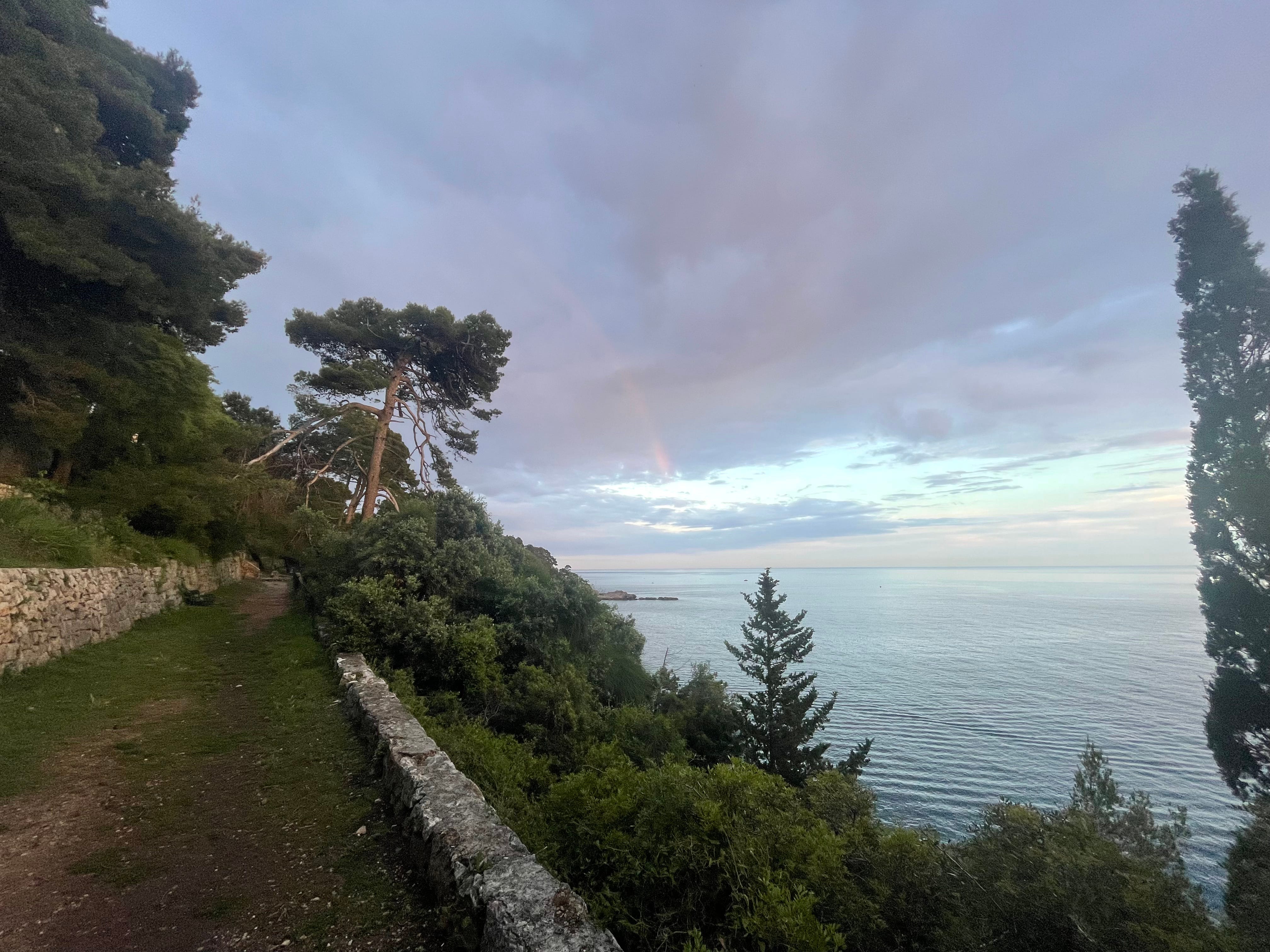
The next day I arose once more and listened to the call of the mountain. I knew exactly what I was going to do with my freedom that day. Climb to the very top. So I put on my clothes, washed my face, brushed my teeth, pulled on my hiking shoes, and opened the door to head out. A cat waited at the top of the stairs to accompany me on my journey. It must’ve followed another tourist in the night before. Together, we walked down the spiral staircase and began the day. Goran’s instructions guided me.
There were two ways I could ascend the mountain. The more direct route with lots of switchbacks or a longer, more gradual trail to guide me up the hill. I chose the softer path so I could enjoy the extended journey. As I stepped — right, left, right, left — I remembered I was accompanied not just by the ancestors whose stories lived in my body, but also the wisdom of activists before me. I thought about Martin Luther King, Jr. Step by step he made his way to the mountain top to see the Promised Land. His vision was of “The World House,” where everyone would be celebrated as equal. King dreamed of a supportive and safe extended community. In his last book he answers the question, Where Do We Go From Here? Chaos or Community?, by singing:
“The large house in which we live demands that we transform this worldwide neighborhood into a worldwide brotherhood.”
Step by step I made my way up that hill. The horizon to my right reminding me of the vision I shared with Kouchner of a family without incest. The sun highlighting my memory of Sol, who guided my daily freedom practice. The land at my feet reminding me of the mountain Pearl gazed upon. And the sea that now stretched before me in a city also called, “Pearl,” after I renamed myself, “Josephine.”
Liberation from oppression is our intergenerational destiny. My freedom reaches back in gratitude for the commitment of the ancestors and activists before me and lends a hand forward to ensure the safety of the next generation of children.
I climbed back down the mountain top, then walked the stone, slippery streets back to my hostel in this old town. On the way, I breathed in the freedom of this fortress. The walls still here, but walked, not watched. The cannons now busted, not blasted. The water wading against the rocks. Stone by stone, step by step, for the next week I practiced my freedom in this place and pondered my commitment to peace, a new dream for all of humanity.