
Content Invitation: this post mentions incest abuse.
If you’re seeking resources, head over to Incest AWARE or Sibling Sexual Trauma.
Last December, Ruth and H visited me in my tiny, toasty basement studio nestled against the only old-growth forest on the northernmost tip of Manhattan. By the time they arrived, the moon had risen above the Hudson, so we – unlike so much of the city — prepared for bed. Fiercely independent but under 40 inches tall, H tried and failed to hoist herself over the pack-n-play. So Ruth set a step stool near the crib to assist her. Quickly, she climbed to stand on the top of the seat, then launched herself into the barely-a-mattress, landing face-first.
“Me okay!” She reassured us.
“Good night, H!” Ruth and I said, as we repressed our giggles.
With the window slightly ajar to allow the radiator-heated apartment to breathe, we fell asleep — Ruth and I lying head to feet in my bed behind a sand-tan linen curtain that separated us a bit from the snoring kiddo in the office nook. Hours passed until the early winter light dashed through the windows. So I arose and gazed out, thrilled to see snow falling into feet of plush powder on the sidewalk. Giddy, I roused Ruth to share the news. H arose soon after. We dressed in weather-ready clothes quickly, so we could all comfortably meet the chilly surprise outside.
As soon as we scaled the basement steps, we saw that just to our left stretched the heavy white coats wrapped around the leafless tree trunks and outstretched branches, as well as the fuzzy blanket of partially packed powder on top of the paved pedestrian path. H — unaccustomed to her puffy winter layers — stumbled by me, bent over at the waist, packed snow into her glove-covered hands, then questioned me with a conniving grin:
“Jo., you ready? Me going to throw snowball at you!”
“H, are you ready?” I asked right back. “I’m much taller than you, so I can make much bigger snowballs. Are you sure you want to start this game?”
She paused for a moment, contemplating. “Okay Jo, me idea is: you make me big snowball, put in my small hands. Then me throw snow at you!”
“That’s not how this game works, H!” I admit my competitive side got the best of me. “How about we both make snowballs and throw them up in the air together?”
“Me like that idea!”
So we packed the soft substance into balls, while Ruth pulled out her phone to record a video. “Okay, on three,” Ruth counted. “One…two…three!”
“Wahoo!” I screamed and tossed my ball into the air, then looked at H. She had thrown her own handful of fluff right into her face.
We all laughed, “You okay, buddy?” I asked, while wiping her off.
“Me okay!”
We kept toddling up the path, our feet crunching underneath us.
“Thanks for taking us on this walk, Jo.!” H joyfully expressed.
My heart leaped in my chest. “You’re welcome, buddy!”
“Me want to live here!” she confessed.
My eyes darted straight to Ruth’s. She knew exactly what I was thinking.
“Don’t you dare encourage her!” Ruth warned with a stern look that needed no words.
I adored my life in New York City. The skyscrapers and lights-on-all-night and diversity and cultural activity resonated with the part of me who had been waiting my entire life to live that fully. But my heart hated living across the country from my chosen family. Also, I always missed the sea. For years, my heart had been oscillating, trying to decide whether to stay or leave.
As I approached my fortieth birthday, I sensed my father’s story ending within me. I could feel the purpose of my being thus far — first devoted to surviving him, then recovering from him, then advocating for accountability for behaviors like his in systems — concluding. I could hear my body asking me to release both him and the work that kept my life focused on the consequences of his actions.
By 40, my father wanted to be a millionaire. He succeeded.
By 40, I wanted to be free of the life that he passed down to me. Would I succeed?
In some ways, I felt so proud of who I had become and how I had designed my life since I first moved away from home over 20 years ago. For the last two decades, I shaped my activities around agency and novelty, deconstructing the monotonous trap that was my father’s reality and rebuilding my own by learning and exploring and loving new places and people and projects. But in other ways, I felt deeply lonely for more constancy: for family, for community, for partnership, for a committed career path. Finally, I felt ready for stability, for groundedness.
Should I settle down so far away from my family?
I took myself out on a walk to process, passing by so many things I knew I might miss about New York City: the density of brick architecture rarely seen in any state split by fault lines, residences shooting up instead of spreading out, bodegas and restaurants sprinkled on every corner, a beautiful park overlooking the river with a castle-like museum sitting right on top, gardens and flowers interrupting all the noise, the accessibility of public transit. Even the infestation of the rats made this place feel like freedom.
I love this city so much. One voice said in my head.
But I love my family more. Another voice contested.
And so the decision was made. By January, I found an apartment — next to the sea and just 30 minutes from Ruth’s house — on Craigslist, bought a car over the phone to accommodate a lifestyle no longer easily dependent on public transit, and packed a U-Haul box with a studio of furniture, clothes, and other belongings. In February, I flew my body back to a region I once called home to be closer to chosen family.
Happy 40th birthday, Jo.
I thought to myself while a medical technician asked me to remove my top, stuck a flowery sticker with a pink plastic tip on my nipple, lifted and shifted my breasts into various positions, and squeezed them into the mammography machine.
“Is this what you do all day?” I asked her playfully, trying to break the ice in this instance of immediate and involuntary but necessary intimacy.
“I know, right?” She caught my tone. “I need a new job!”
“At least you get to spend your day outside of the human body,” I suggested.
She laughed infectiously, “That’s a very good point!”
The technician completed the scan, so I thanked her for her time and awaited the findings. Days later, the email with the subject line “New Results” arrived. As it turns out, I have a cyst in my left breast. I held my breath.
“Do you have a history of breast cancer in your family?” The physician asked.
“Not that I know of, but I haven’t been in contact with my biological relatives for over 10 years.”
“Aw, I see,” the physician responded, and then requested I return in a few weeks for more tests.
Experiencing a health scare without a medical map of my family history is a unique kind of loneliness, so I called my older friends who had been through it for support. I shared how I held the possibility of a breast cancer diagnosis with ironic sadness. At 40, I was finally beginning to feel free within my body. After two decades of deep listening following a childhood of silenced somatic suffering, my chronic health conditions finally felt manageable at best and annoying or embarrassing at worst. IBS and complex PTSD flares still keep my life more gassy and sassy than I like. I returned to the hospital on the day of my follow-up appointment.
“We did it!” the mammogram technician celebrated, after she successfully captured the necessary images to clearly see the cyst in my left breast. She directed me to the ultrasound tech to complete the job. Immediately afterward, the doctor entered the room to tell me that the cyst is likely benign and to return in six months for a checkup. My body shuddered with relief. My fifth decade would not begin with another oppressive health condition to manage. All of my other preventative tests also returned normal. Finally, I was as healthy as could be for a body that held my history.
Happy birthday to you, Jo.!
H sang to me in a video sent by Ruth that foggy morning in July that marked my fortieth year around the sun. To celebrate my birthday, a friend from NYC flew out to California to visit me in my new home by the sea. We planned to hike in the redwood trees, then head to Ruth and Oliver and H’s house for dinner. My family greeted us at the bottom of the orange wooden steps with a spray-painted sign that read 40. The house smelled sweet and savory, as they announced the birthday menu: pulled pork and pineapple tacos. They spoil me.
I went to bed that night thinking on a conversation that a friend and I had recently about people who celebrate two birthdays. First, the one we all assume: their entrance into this world, the celebration of their vaginal descent, the day the stork dropped them off at the doorstep. The second is — in a way — chosen: the day they came out to their families, the day they quit their practical job to follow their dreams, the day they remembered their entire story or chose to share it with others.
That morning I claimed my second birthday on my first birthday, just 40 years later. Numbers hold ancient meaning across time and place and culture. In Hebrew numerology, 40 means: a period of preparation and purification, renewal. Noah spent 40 days on the ark. Moses and the Israelites spent 40 years on route to the promised land. Jesus wandered 40 days in the wilderness before his public ministry. My first 40 years, I decided, prepared me for the rest of my journey — whatever that may be.
Many people have been sharing their own experiences of their fifth decade of life, assuming that my journey would be the same.
“Your forties will be like your second twenties,” some celebrated. “There’s freedom to do what you want, but with more money!”
“Oh, forty,” others mourned, “That’s when everything starts hurting. Just you wait.”
I listened to their stories, while simultaneously and silently accepting that I was to begin this decade celebrating the absence of things. First, I released the health crises that so greatly constrained my life and my bank account. Second, I released my father’s story. I chose to let go of the hope that a literary agent or traditional publisher would represent me or my work and self-published my memoir. I also announced my retirement from Incest AWARE after building a non-profit board of eight others. By the end of the calendar year, I will have disseminated all of my institutional knowledge to those committed to the labor of love that is anti-incest work.
I knew now what I was free from, but felt less clear about what I was free for. In this transition, sometimes life feels spacious: like the endless horizon I see at dawn when walking to the ocean to say good morning. I feel playful, giddy. One of my friends calls this, “The Newness,” the resonating excitement of nascency, like falling in love again after heartbreak. Other times, this spaciousness is filled with anxiety and worry and longing and loneliness. Once again, my identity is shifting out of one way of being so familiar to me and into another, still a mystery. The words of Michaela Angemeer guide me:
“what if I’m not my mother
or my father
but something else
what if I am their alchemy
what they didn’t get the chance to be
what if I am a third and more hopeful thing”
“Happy birthday to you, Jo.!”
My friends — who I consider my extended family — sang to me in Seattle at Alicia’s house. She flew me up to the Emerald City and threw me a fortieth birthday party. The already elegant townhouse — in a neighborhood I had once lived — had been decorated just perfectly. A light green gingham cloth covered a long table with white, rented chairs set neatly around it. Blankets sprinkled around the grass areas for kids to sit and play. A Happy Birthday banner hung in two joining crescents from the covered patio roof. Just beyond it another cloth-covered table held up piles of fruit and veggies and dips and a massive pot of chili and chips.
“We did it, Jo.!” My friend celebrated the perfect party she hosted for me.
“You did it!” I replied, “I just turned forty.”
“No, we did it,” she corrected me.
We both knew that my fortieth meant so much more than I gave it credit for. I smiled humbly, as she subtly invited me to see this party as the commencement it was meant to be — both an end and a beginning.
“Healing is a homecoming.”
A friend shared with me during a support group for those of us who share a history of incest abuse. These words gave substance to this silent feeling settling into my body. This home-fullness I felt in my new life by the seaside, especially when sharing the company of my family.
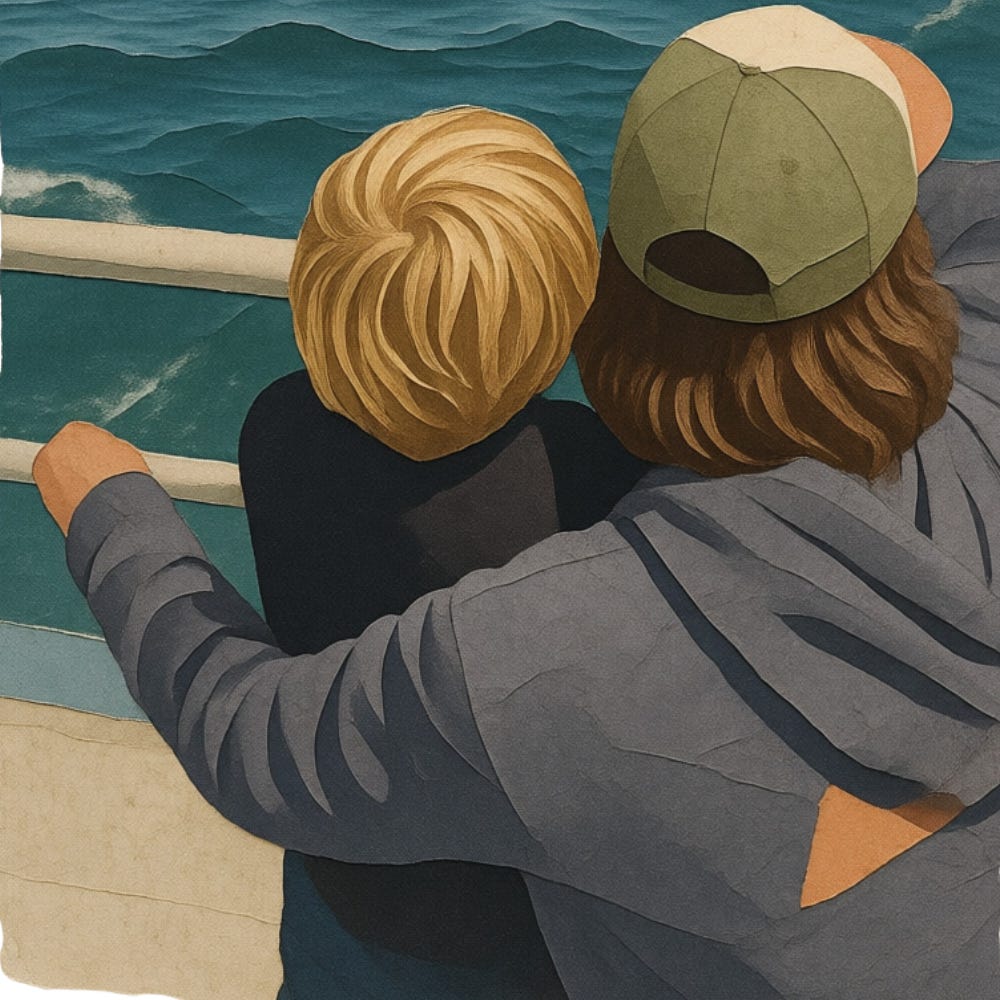
Recently, I scooped up H to take her on what we’ve come to call a, “Harry Jo. day.” Ruth and Oliver retreat from parenting, while we connect one-on-one. Together, we chose to go to the beach. So I drove H to the sea to spend the day in the sun, with the sand, and on the water. On the way, I sneezed.
“Oh, no!” I mourned.
“What’s wrong, Jo?” H asked empathetically.
“I just peed my pants a little,” I responded.
“Why, Jo.?”
“The muscles in my pelvis are weaker than they used to be. But don’t worry, I’m okay. This happens to lots of people when they get older.”
She sat in silence for a second, then responded, “Jo., you’re not getting older, you’re getting newer.”
“You’re so right, H.”
I sighed, relieved that this nearly four-year-old could so simply describe what exactly was happening to me as I transitioned into the fortieth year of my life.
Happy Birthday beautiful friend!!! 💐🌷🌸💜🙏🏼🤗