Content Invitation: this post mentions incest abuse.
If you’re seeking resources, head over to Incest AWARE or Sibling Sexual Trauma.
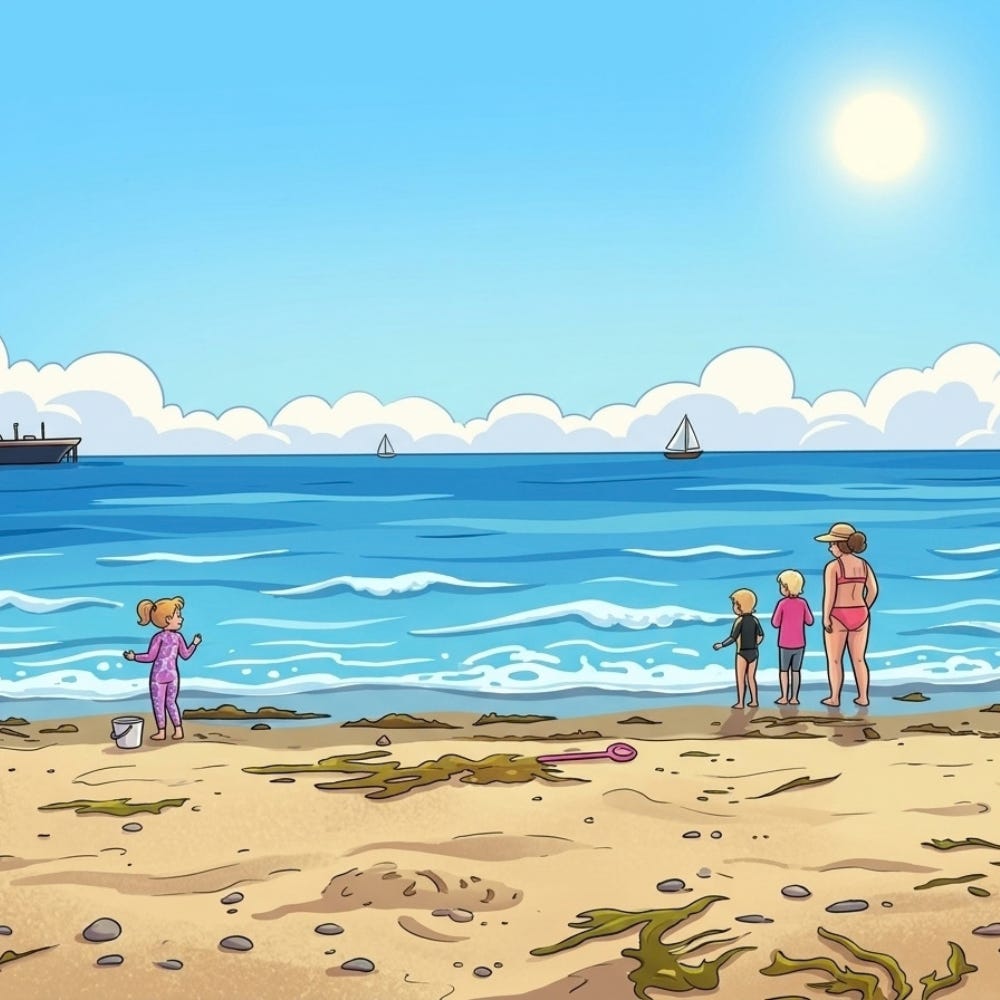
I spent my summer as I did so many in the past: at the beach, playing in the waves, building castles, and catching crabs. The difference between this summer and the summers of my childhood was that now I was the grown up, playing with H and her two cousins who circled around me excitedly.
“What is that?” They asked nearly simultaneously, as I wrapped the neon orange strap around my belly and snapped the latch into place.
“It’s a swim buoy,” I answered. “I blow it up with air and it floats on the water behind me so that boat captains and lifeguards can see me swimming.”
“It keeps you safe!” The oldest one celebrates.
“It does!” I joined them. “Also, I can store stuff inside it. So I’m going to bring a few sand buckets and try to catch crabs for you!”
I had worked out how to swim out far enough to find some sizable crabs—with both of my arms free to pull my body through the waves while the buoy carried the catchers—but not how I would swim back with crab-filled buckets in hand.
That’s a problem for future Jo, I repeated this borrowed mantra from my best friend, as I prepared to high-knee hop through the white wash into the wave break. The oldest of the three kiddos pulled me aside.
“Jo., do your best,” he said with a smile stretched across his sweet face, “but I might be kinda mad if you don’t bring anything back.”
“Noted,” I replied, giggling inside over this not-so-subtle emotional manipulation by a seven-year-old. “I promise to do my best, but I can’t promise to bring anything back.” I set the expectations straight.
“Deal?” I asked.
“Deal!” He playfully rolled his eyes and walked back to his cousins.
“Go, Jo!” The three kiddos called. As my body adjusted to the frigid water, they gathered sand and seaweed and rocks into a large clear container to serve as a habitat for whatever I brought back. Then I dove under the sea and started swimming.
My body is a habitat of memory.
I thought to myself while recalling the words of the EMDR therapist who belonged to the handful of people who saved my life.
“One day, you will be filled with good memories in the same way you’ve been flooded by recovered traumatic memories.” She explained, “For now, the trauma fogs everything, but one day the whole story will be clearer to see.”
The fog is clearing in this new life I have chosen by the sea. This community is more diverse and progressive than the one that surrounded me during my early days in Southern California. But otherwise, the joy of today reflects my loves of yesterday. Days spent on the beach, skin chilled by salt water, then warmed again by a sun that rose just to spoil me.
I witness the joy in the three kiddos, as I feel my own latent joy of childhood days spent similarly. This emotional memory builds a bridge in my body. Psychologically, I sit right in the middle of it: looking back to what was, looking forward to what will be. Grieving all I’m releasing in this next phase of my journey, considering whether or not I’m worthy to accept all that’s right for me now, and receive whatever’s awaiting me next.
It wasn’t that I couldn’t see the crabs, it was that I couldn’t catch them. They scuttled across the top of the sand, while other heavy things—rocks and shells and carcasses of formerly living creatures—sat still on top. But between diving to the surface of the sand—the buoy restricting my depth, spotting the crustacean, holding my breath, and resisting the strong pull of the currents, the crabs remained just out of arms reach. I needed a new strategy.
So I strapped my buoy to the top strap of my bikini, swam to shallower water, rested to recover my capacity to hold my breath, and dove deep once again. After a few tries, the bucket finally held sand, water, and an impressively sizable crab for this amateur catcher.
“I caught one!” I called to the kids, who ran to the shoreline and impatiently waited for me to exit the sea.
“Woah, Jo.! Put it in our habitat!” So I did.
Other kids noticed and surrounded the clear container to gaze at the DIY-mini-aquarium the kids and I co-created together. I love this most about my family: we have a habit of bringing people together by simply engaging our curiosities and sharing them publicly.
I took a deep breath to settle into the moment. I am still practicing tolerating all this play, all this beauty.
Days later, sitting on my mat, the ocean air still lingering in my lungs, I tried to ground myself. Olive skinned with teal blue eyes, my yoga teacher guided fellow yogis and me as we transitioned our bodies through various asanas, those positions and poses that make us more flexible, more strong, more whole. My body felt energized but not quite ready. Heavy, tight, and unfocused, the shifts from one position to the next felt hard and awkward and frustrating.
Then together, we stood up like trees, legs rooted into the ground, hands stretched to the sky, then we rested our arms down by our sides. We simply stood there.
“Mountain pose!’ my teacher called with a surprising amount of intensity. “This asana is active. It demands you be as big and as solid and as clear as a mountain that claims, I AM HERE!”
I am here.
I repeated internally, as I considered my psyche presently sitting on the bridge between my past and my future, learning to hold my present lightly. I thought of H, my best friend’s now four-year-old, the most present person I’ve ever met.
She often reminds me of who I could’ve been if I had been more free as a child. Aggressive and creative and brilliant and queer and curious and powerful, she is a lotta bit of absolutely everything.
Around H, my inner child comes alive. The one so fatigued from the work to survive and the labor to liberate, and the rest to recover, and the love letter written to create a safer place to land for other incest survivors. In loving H, I’m learning how to love the parts of myself that I hid to survive. In playing with H, my little one finally practices releasing the weight of responsibility and tolerating the lightness of play.
My EMDR therapist once told me at the beginning of my recovery journey that my inner child should never come to the present. Instead, I was to visit her in the past and help her to heal back there.
“She doesn’t belong here,” my therapist said.
I believed her then and have tried my best to listen to my inner Annie and speak to her and fix her and heal her all back in the past. It all helped, but Annie’s never stopped demanding to be present. She’s never ceased to be with me. I used to hate her constancy, but I embrace her now. I accept just how much we belong together. She, like H, can’t help but be present.
In some ways, I believe she is the best of me. The resilient one, the observant one, the tireless one, the one who frequently reminds me that she didn’t survive seizures and surgeries and sexual violence to settle in life. To stay in jobs and relationships and places that don’t always call me awake. She fought for our freedom, so naturally it’s my job to be free. And when I don’t, she roars in my body with physiological and psychological symptoms to not-so-gently remind me.
We are here.
I remind myself, as I learn the difference between settling and settling in. For the past 20 years, I’ve jumped from place to place, career to career, friend to friend, trying to find the next best fit. Then I found it: this life, and this body, and this home, and this people. But I have to practice being convinced. To hold both truths:
We are here—and—we can stay here.
I prepared to head back out to the sea to catch more crabs for the cousins and the stranger children who had become fast friends.
“I’m going back out!” I called to the kids.
“You going to bring your booty, Jo.?” H asked curiously, noticing the bright orange blow ups absence around my waist.
“Yes, I’m going to bring my booty,” I pointed to my booty, “but not my buoy.” I overemphasized the difference in pronunciation. The kids laughed, and I returned to the sea.
We can hold good memories.
I repeated to myself as I settled into home. Now, dry and sun-kissed and solo, I revisit all these glorious memories to teach the habitat that is my body that she can hold the life of them with the same exuberant joy the cousins felt when clinging to crustaceans.